
Buddhism has deep roots in Nepal, the birthplace of Siddhartha Gautama, the historical Buddha. Nestled in the Himalayas, Nepal holds a special significance for Buddhists worldwide, attracting pilgrims both monastic and lay followers and scholars seeking spiritual enlightenment and cultural heritage.
Buddhism has been practiced in Nepal since the time of the Buddha himself, over 2,500 years ago. Siddhartha Gautama, born in Lumbini, Nepal, attained enlightenment in Bodh Gaya, India, and preached his teachings across the Indian subcontinent. Throughout history, Nepal has been a hub of Buddhist heritage sites and scholarship, attracting monks and scholars from across Asia.
Nepal hosts various Buddhist sects, including Theravada and Mahayana traditions. Tibetan Buddhism, particularly the Vajrayana tradition, has a strong presence in regions bordering Tibet. Newar Buddhism, indigenous to the Kathmandu Valley, combines elements of Mahayana and Vajrayana practices.
Buddhist festivals are celebrated with fervour and devotion in Nepal, reflecting the country’s rich religious and cultural heritage. Buddha Jayanti, commemorating the birth, enlightenment, and death of Buddha, is a major festival observed nationwide. Other festivals include Losar (Tibetan New Year), Lhosar (New Year for Sherpa community), Lhabab Düchen (celebrating Buddha's descent from heaven) and Mani Rimdu (Sherpa festival celebrated in the Everest region).
Key Buddhist scriptures, such as the Pali Tripitaka, Mahayana sutras, and Tibetan Buddhist texts, are studied and revered by Nepalese Buddhists. These sacred texts provide guidance on ethical conduct, meditation practices, and the path to enlightenment.
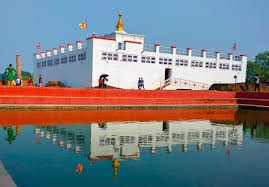
Birthplace of the Buddha is a UNESCO World Heritage Site. Buddhist monasteries with its unique architectural style and spiritual significance.
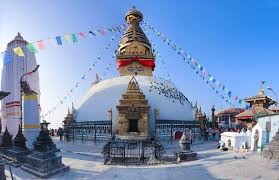
The most ancient and enigmatic of all the holy shrines in Kathmandu valley. Historical records found on a stone inscription give evidence that the stupa was already an important Buddhist pilgrimage destination by the 5th century AD. Swayambhunath's worshippers include Vajrayana Buddhists of northern Nepal and Tibet, and the Newari Buddhists of central and southern Nepal.
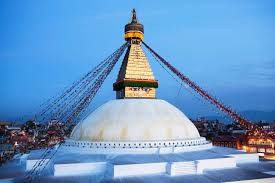
Boudhanath Stupa also called Boudha is a stupa in Kathmandu, Nepal. Boudha stupa is semicircle shaped and contains the relics and remains of Buddha. The stupa’s massive mandala makes it one of the largest spherical stupas in the world. Boudha Stupa was listed in world heritage list by UNESCO in 1979 and it is one of the most popular tourist sites in Kathmandu.
Buddhism continues to thrive in Nepal, with a significant portion of the population identifying as Buddhist. While exact figures vary, it is estimated that Buddhists constitute around 10-12% of Nepal’s population. Buddhism maintains a significant presence, particularly in the Kathmandu Valley and regions bordering Tibet. The country's diverse religious landscape reflects its rich cultural heritage. Buddhist temples, monasteries, and stupas serve as centres of religious practice, education, and cultural heritage preservation, contributing to the vibrant tapestry of Nepalese society.
One of the prominent government-recognized Buddhist organizations in Nepal is the Lumbini Development Trust (LDT). Established in 1985 by the Government of Nepal, the Lumbini Development Trust is responsible for the overall development and management of Lumbini, the birthplace of Lord Buddha, as a sacred pilgrimage site and a center for Buddhist culture and heritage.
The Nepal Buddhist Federation (NBF) is the main organisation recognised by the government, representing Buddhist communities and institutions across Nepal. The NBF promotes religious harmony, advocates for the rights of Buddhist practitioners, and supports the preservation of Buddhist heritage sites in the country.
The LBU, from the birth place of Gautam Buddha, Lumbini, is an autonomous and public institution of higher learning committed with the mission to educate the people of Nepal and enrich the global learning community through the application of core Buddhist values and to promote the World Peace.
On 14th Marga 2061 B.S. Lumbini Buddhist University was formally established with the promulgation of an Ordinance which was declared on 16th Marga 2061 B.S. at the 2nd World Buddhist Summit held in Lumbini. Subsequently the Main Preparatory Committee meeting held on 23rd Marga 2061 B.S. took six important decisions including renaming of committee as “Lumbini Buddhist University Main Preparatory Committee 2061″ Later in 2062 B.S., the Parliament approved the Ordinance with modifications as Lumbini Bauddha Vishwavidyalaya Ain 2063 (Lumbini Buddhist University Act 2063).
Lumbini Buddhist University has a noble vision of promoting world peace, harmony, and prosperity through its teachings and research. It strives to achieve this by offering comprehensive education in various fields of Buddhist philosophy, literature, education, culture, and other subjects that facilitate the cultivation of precepts and human virtues such as peace, empathy, maitri, and compassion.

Founded by Chökyi Nyima Rinpoche as an institution of higher learning for those wishing to deepen their understanding of Buddhist philosophy and practice, Rangjung Yeshe Institute (RYI) has been conducting seminars and study programs in Nepal for more than 25 years.
Since 2001, the Institute has worked in close partnership with Kathmandu University to manage the Kathmandu University Centre for Buddhist Studies at Rangjung Yeshe Institute which offers undergraduate and post-graduate degree courses in Buddhist Studies and related topics.
RYI may, to a large extent, be regarded as the Buddhist equivalent of a divinity school or seminary where spiritual practice is an integral part of the daily experience and where program graduates are scholar-practitioners.
RYI envisions a world in which a wide diversity of people, interested in studying Buddhism and related research language, have easy access to a living Buddhist tradition in order to foster the qualities of wisdom and compassion for the benefit of all sentient beings.
RYI mission is to be a centre of higher learning, working to the highest standards, combining traditional and academic Buddhist education.